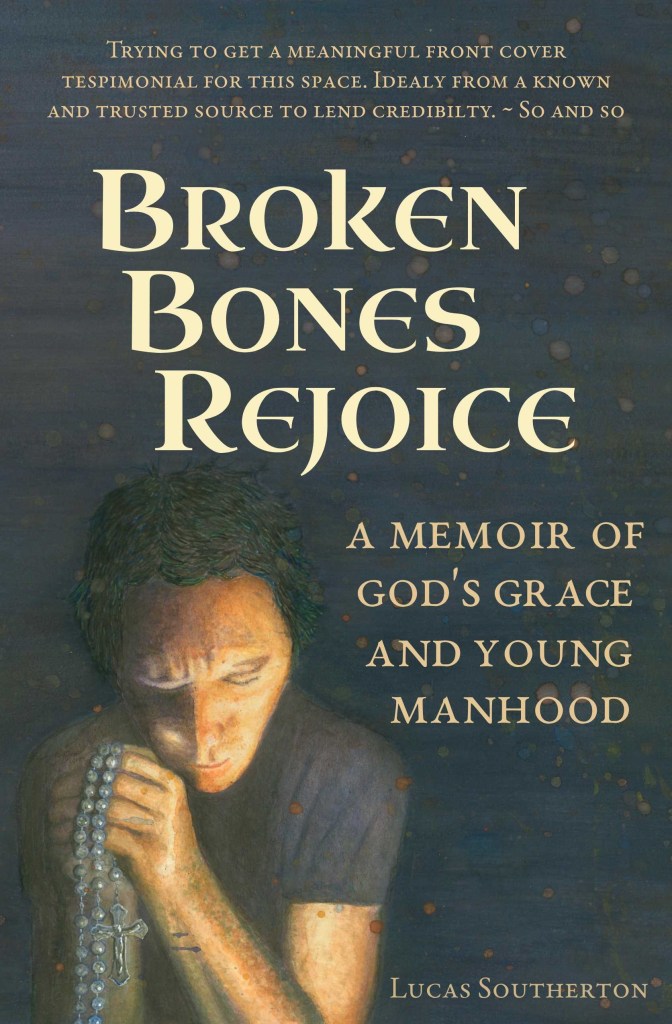
I’m completely ready to publish but am waiting on an imprimatur, which is an official declaration from the Church that a work is free from moral and doctrinal errors. I’m in contact with my diocese to make that happen. Below is preview.
Back Cover Blurb:
Teacher, artist, and street evangelist, Lucas Southerton brings you along on his exciting spiritual adventure into manhood. Raised Catholic but struggling with doubt and shame as a teenager, he leans into his faith in college, finding answers to burning questions, freedom from the sins that bound him, holy friendships, and abounding joy in Jesus Christ. But God has difficult truths to reveal, work for him to do, and a woman for him to love. If he is to persevere through trials to the glory of redemption, he’ll need to humble himself, take up his cross, and draw ever closer to the source of all power and blessing—the Father, Son, and Holy Spirit, Amen. Filled with Sacred Scripture and grace-inspired lessons on salvation history and morality, this memoir offers wisdom and life-changing hope for Christians, skeptics, truth seekers, and all who ache for fullness of life.
Introduction
Remember how for these forty years the Lord, your God, has directed all your journeying in the wilderness, so as to test you by affliction, to know what was in your heart: to keep his commandments, or not. He therefore let you be afflicted with hunger, and then fed you with manna, a food unknown to you and your ancestors, so you might know that it is not by bread alone that people live, but by all that comes forth from the mouth of the Lord (Deuteronomy 8:2-3).
A few years ago, I was blessed to explore the book of Deuteronomy with some good friends and neighbors as part of a community Bible study. The word Deuteronomy means “second law,” and it records the words of Moses given to the Israelites shortly before his death, after which they entered the Promised Land. It’s not exactly a second law, but rather a re-giving of the law he received from God forty years prior in the desert wilderness of Mount Sinai.
What struck me about the book of Deuteronomy was how often Moses told the Israelites to remember all the Lord had done for them. He told them because people tend to forget, at least I do.
That’s the reason why I started writing this book. God had done wondrous things in my life and taken me from a dark place spiritually in junior and senior high school to a much brighter place in college. Over the course of that journey, I considered the priesthood but discerned that God was calling me to marriage. In fact, my wedding day serves as the happy ending of this book that you can look forward to! But it wasn’t long after my wedding that I looked back and realized that I was already starting to forget many of the details of those experiences. Frantically, I wrote things down, and in a few months, I had a large portion of the story written with no intention of sharing it with anybody other than my wife and maybe my future children.
But God was asking me to share my story with a wider audience. Looking at the world, I often see “sheep without a shepherd” (Matthew 9:36). I’m a public school teacher, and I see this lack of direction in my students, but it’s also not uncommon for me to see it in coworkers, neighbors, friends, or family. My heart goes out to these souls, and when their confusion or distress manifests, I feel God tugging on my heart, telling me to share the good news of what he’s done for me and what he can do for others.
But far too often, I’ve remained silent. I spent over a decade on revisions, in part to improve the text, but also to have my heart prepared to share it. Street evangelization has been very helpful to that end, as has each time I’ve shared my story with another person for feedback. Each review from friend, family, or stranger has helped to make the book better, but the most beautiful part of sharing my story with others was the way it deepened our friendships.
I hope that you too find a friend in these pages—a person you can laugh with, a person you can cry with, a person you can trust and learn from. And I hope God chooses to use this book to draw you closer to himself, because it’s really not about me, it’s about him—his goodness, his power, his mercy, and his love.
Praise be Jesus Christ! Glorify him now and forever! Amen!
Chapter 1: My First Semester of College – In Need of a Savior
A New Beginning
A gentle breeze swept over the water beside the highway, and as I gazed out the window of my family’s van, I wondered who I would become.
It was move-in day for my freshman year of college, and the anticipation I felt was as thick as the mop of brown hair on my head. For the first time, I would be on my own. Nobody there would know me, and I would be free from expectations.
Both my parents were in the van with me. They were wonderful people—school teachers and well-loved in our community, church, and home.
I was the middle of five siblings, all involved in various clubs and sports, and generally performing well. I was hardworking, polite, cooperative, and fair. I was proud of who I was and all I had accomplished.
But if I slowed down and gave an honest look at myself, I wasn’t who I wanted to be. I didn’t even have a clear vision of what that might look like. There was a lingering cloud of shame that kept me from looking too hard.
By any worldly standard, I was a good kid, a really good kid, but what does that even mean? In a certain sense, everybody is good. God made us, and God doesn’t make mistakes. Our intrinsic goodness is something we’re given by our creator, and nothing can take that away from us.
But in another sense, none of us is good enough to merit a share in the divine life. None of us can get to heaven by our own efforts. In fact, as a human race, we’ve merited just the opposite.
We’ve sinned. We’ve fallen from God’s grace. God made a perfect world, and we’ve broken it by our own free will, and now we suffer the consequences.
But there is reason to rejoice. We can recover God’s grace, and we can look forward to the redemption of the world and of our own story, but only because God is “gracious and merciful, slow to anger and abounding in love and fidelity” (Exodus 34:6).
I had heard all this before in my religious education, but it hadn’t set in. Perhaps it would in college.
God looked at everything he had made, and found it very good (Genesis 1:31).
Made for Community
The campus was abuzz with activity. It was a medium-sized state university in Pennsylvania, and I was enrolled to become a school teacher, like my parents. I found my dorm room down a hallway and up two flights of stairs.
My parents helped me unpack, and right before leaving, they gave me a hug and kiss and reminded me of the Newman House on campus and the ice cream social advertised to happen there later that week.
The Newman House was the center for Catholic Campus Ministry. I was raised a Catholic Christian, and my family went to Mass regularly, where my mom led the singing, and my dad played guitar. Our faith was an important part of our family identity. I believed in my Catholic faith, and I tried to live up to its high moral standards, but it was hard, and I often failed, contributing to the cloud of shame in my soul. There was a part of me that wanted to give up trying to be a Christian for a time. Wild parties and aspects of the hookup culture carried a certain appeal to me. To an extent, that culture existed at my high school, but I wasn’t part of it, and I thought maybe I was missing out.
But I also thought I might find a wife at college. My parents, grandparents, and other extended family offered wonderful examples of successful marriages. I wanted that, plus it’s what was expected. Living too wild a life could mean missing out on a good wife. I also didn’t want to go to hell.
For better or for worse, I didn’t click well with my roommates. One made it clear on the first day that we weren’t supposed to cross an imaginary line in the room between our stuff and his, and afterwards, we rarely spoke. The other was friendly enough, but never around.
Midweek, I made my way to the Newman House not because I wanted to grow in my faith, but because I was lonely. I wanted a place to fit in, and since I had spent my whole life around Christians, they were the people I tended to fit in with, plus hey, free ice cream!
The Lord God said: It is not good for the man to be alone (Genesis 2:18).
In the Image of God
Walking through the wide open doors of the Newman House, I was immediately greeted by a Catholic priest who shook my hand, introduced himself, and handed me off to some upperclassmen who enthusiastically welcomed other freshmen and me into their circle of conversation. Standing among the members, I nodded, smiled, and laughed, and I wasn’t faking it. I was really enjoying myself.
After ice cream, we played volleyball and dodgeball, and I kept ending up next to a girl named Lillian Dreisbach, who wore a flowing dress and a beret. Lily was friendly, excitable, and a bit eccentric. She had been coming to the Newman House for two years and was more than willing to tell me what the John Newman Association had to offer, including a free dinner prepared by students every Wednesday afternoon. I was hooked.
The very next day, I went to see a live band play in the club basement of the student center. There, I sipped on a peach iced tea and tapped my feet to the indie rock music that dominated the college music scene in 2004. I heard some playful laughter over the gritty guitar and noticed a group of students playing a fast-paced multiplayer version of billiards.
“Hey, can I join?”
“Yeah, man, hop in.”
When the game was over, they told me about a pickup ultimate Frisbee game that happened every Thursday on a large grassy field between the residence halls. The first game started at 10 pm, went till midnight, and was played with a light-up disc. How cool!
When I showed up, I learned that most of the organizers attended the University Christian Fellowship, the primary Evangelical Protestant option on campus. We gathered in a large circle, held hands, prayed a short prayer, and counted off by twos to make teams. The game was super competitive, but people were good at including all skill levels and remembering that we had all gathered to have fun. There was plenty of cheering and high fives, and by midnight, I was covered in grass stains, sweat, and a glow of happiness.
As people were leaving, I noticed a girl from the other team with short brown hair looking for her student ID card in the grass near the trees. I offered to help, and we introduced ourselves. Her name was Tabitha Whitman, and she’s the girl I would someday marry. She was friendly, talkative, and laughed easily. I immediately found her very attractive, but I quickly learned she was in her third year and had a boyfriend, so I didn’t consider that we would ever date; but even so, I thought it very likely that we would become friends.
A few days later, I took a job at the campus deli where I worked the 7 am shift with a friendly girl named Bethany Miller. Bethany had curly black hair that she kept back with a tie-dye headband, and she was friendly even at 7 am. It wasn’t long before I started attending a Monday evening Bible study she led through Intervarsity Christian Fellowship.
So, within the first few weeks of college, I found myself involved in three different Christian organizations on campus and loving it.
I couldn’t have put my finger on it then, but it’s clear to me now that I was attracted to these groups largely because of these beautiful young women. Were they physically attractive? Well, sure, and that was probably part of it, but the beauty I saw in them was much more profound and manifested itself through subtle gestures of virtue and grace. I wanted more of what I saw, but I also felt the duty to protect and honor it, which I could only do if I grew in virtue myself.
These young women weren’t perfect, but they helped me to see something I’m still learning to see in all people: the image of God.
We are all made in God’s image and likeness. This teaching is a central component of a Christian worldview. Humans have the capacity for knowledge, freedom, and relationships. We have an intellect and will. We can love. This astounding capacity exists because we have a spiritual soul, which, by God’s grace, can live with him forever in heaven! We all have a high calling and a great dignity, and God calls us to treat one another accordingly.
It’s one thing to hear this message in Sunday school. It’s another thing to look at any human being and have the eyes to see them as God does.
In the image of God he created them (Genesis 1:27).

